GuidesCV & recruitment
How to write a CV in Poland in 2026 – structure, template and tips for IT
How to write a CV for jobs in Poland in 2026: the structure recruiters expect, your work status line, a ready template, ATS rules and tips for IT roles.
By LITJobs editorial team · LearnIT experts8 min read

Contents
How to write a CV in Poland – the short answer
To write a CV for a job in Poland, keep it to 1–2 pages, tailor it to the specific job ad and describe what you achieved rather than listing duties. Use this order: contact details (including work permit status), summary, experience, projects, education, skills and languages – and finish with the data-processing consent clause, which Polish recruiters are used to seeing.
This guide is written for people applying to Polish employers from abroad or after moving to Poland. Below you will find each section, a template, ATS rules and tips for IT roles. The consent clause itself – exact Polish wording, English translation and where to put it – has its own guide: GDPR clause for a CV in Poland.
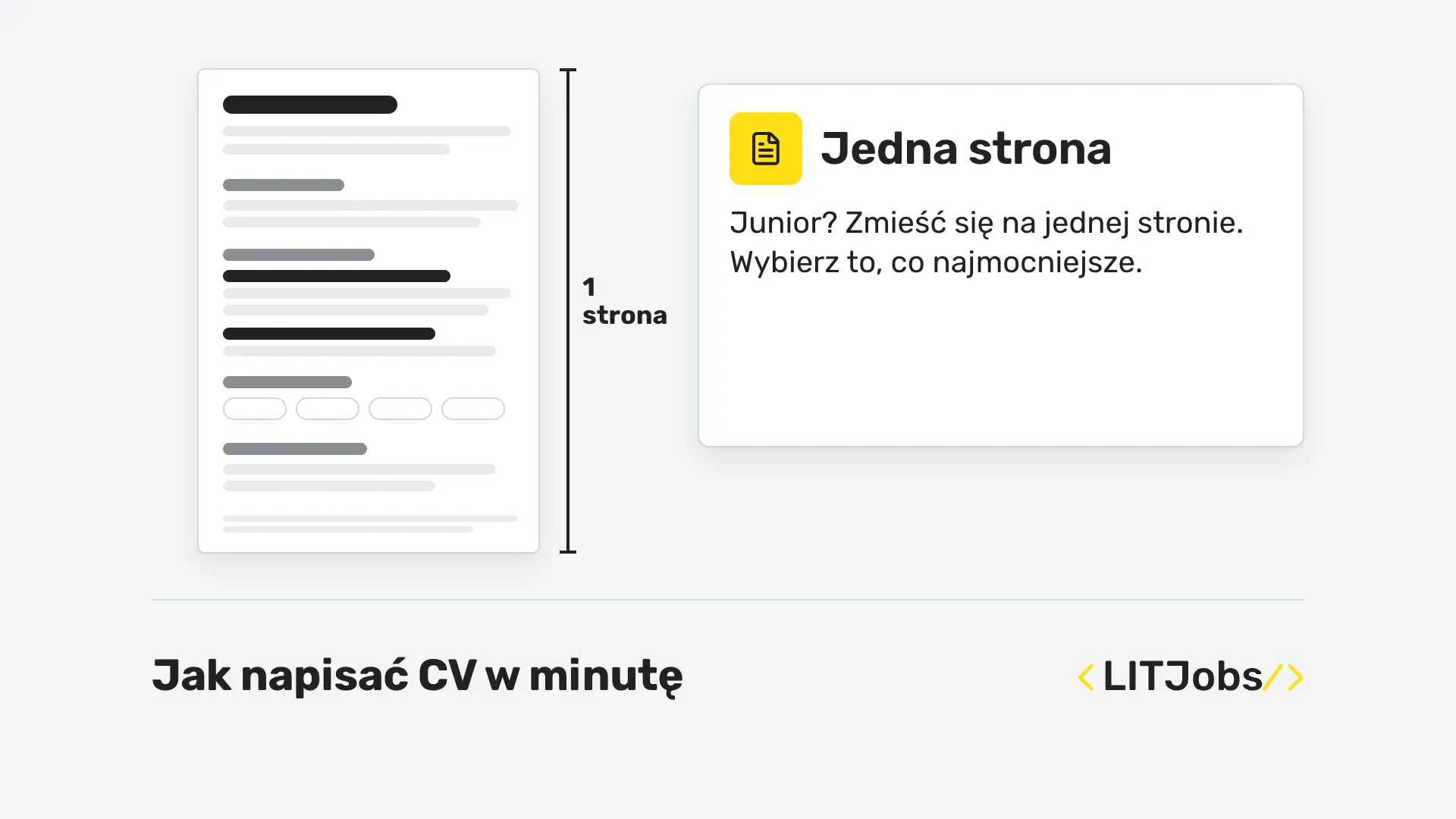
How to write a CV in a minute
60 s · Polish voice-over · Polish captions, English subtitles
Video transcript
Your CV in a minute: what to include and what to avoid. At the top: name, e-mail, phone, city and a GitHub or LinkedIn link. Summary: 2–3 sentences on who you are and what you're looking for. Experience or projects: newest first, with results. Skills and languages — specific and matched to the offer. Education and courses — briefly. ATS-friendly: a simple layout, standard headings, keywords from the ad. No tables or text inside images — the system may not read it. A GDPR clause at the bottom: not mandatory, but worth adding. Junior? Keep it to one page. Add your finished CV to LITJobs — your contact details stay hidden. Add your CV for free.
What makes a Polish CV different
The structure is close to a standard European CV, but a few details differ:
- The consent clause (klauzula RODO). RODO is the Polish name for the GDPR. Most Polish CVs end with a sentence consenting to the processing of personal data for recruitment. More on this below.
- What the employer may ask for. Under Article 22¹ of the Polish Labour Code, an employer may require from a candidate their name, date of birth and contact details and – when necessary for the job – education, professional qualifications and employment history (Zielona Linia, UODO). A photo, marital status, nationality or religion are not on that list, so they are optional. Since 24 December 2025 the employer may not ask about your current or previous salary either (Labour Code, Art. 22¹).
- Date of birth. It is on the list above, so some Polish CVs include it. You may leave it out of the CV itself; the employer can ask for it later in the process.
- Language levels. Recruiters expect levels on the CEFR scale from A1 to C2 (Council of Europe), e.g. “English C1, Polish A2”.
- Contract type. Many IT offers in Poland are on a B2B basis (you invoice as a sole trader) rather than an employment contract. You do not need to state a preference in your CV, but be ready for the question – see our comparison of B2B vs employment contract.
CV sections, one by one
- Step 1Contact details and work status
name, phone with country code, e-mail, city, LinkedIn; one line on your right to work
- Step 2Summary
2–3 sentences: profile, key skills, what you look for and from when
- Step 3Experience
most recent first, 3–5 results-based bullet points per role
- Step 4Projects
especially in IT – problem, tools, link
- Step 5Education
original name of the school plus translation
- Step 6Skills and languages
tools with context, CEFR levels A1–C2
- Step 7Consent clause
at the very bottom, in Polish or in both languages
1. Contact details and work status
Full name, phone number with country code, e-mail, city (no full address needed), LinkedIn, portfolio or GitHub. Add one line about your right to work, for example:
- “EU citizen – no work permit required”;
- “Residence card with access to the Polish labour market”;
- “Requires work permit sponsorship”.
Use the exact name of your document and do not overstate your status.
2. Summary
Two or three sentences: who you are professionally, what you are good at, what you are looking for and from when. Example: “Customer support specialist with three years in e-commerce, handling around 60 tickets a day in a CRM. Moving to Wrocław in January, looking for a first-line IT support role. English C1, Polish A2.”
3. Experience
Most recent first. For each role: job title, company, city or “remote”, month and year of start and end, then 3–5 bullet points built as verb + what you did + result or scale. Keep the original company name, and if it is not well known in Poland, add a few words about it: “(logistics software company, 200 employees)”.
4. Projects
Especially important in IT and for career changers. Name, one sentence about the problem it solves, tools used, link to a repository or demo.
5. Education
University or school, field of study, years. Use the original name of the institution plus an English translation if needed. You do not have to explain grading systems.
6. Skills and languages
Separate hard skills (tools, technologies, licences) from languages. Give context instead of rating bars: “SQL – daily reporting queries, joins, window functions”.
7. Consent clause
At the very bottom, in a smaller font. See the next section.
The consent clause in brief
For the basic data listed in Article 22¹ of the Labour Code, the legal basis is the law itself, so formally no consent is needed for the current recruitment. Consent is needed when your CV contains extra data (for example a photo) or when the company is to keep your CV for future recruitment. Most Polish recruiters still expect a clause, so add it at the bottom. The short version published by the government service Zielona Linia reads:
Wyrażam zgodę na przetwarzanie moich danych osobowych przez [nazwa firmy]
w celu prowadzenia rekrutacji na aplikowane przeze mnie stanowisko.
The English translation, the version for future recruitment, when to use the employer's own wording and what to do when applying outside the EU are covered in our separate guide to the RODO clause on a CV.
CV template for jobs in Poland
[FULL NAME]
[Target job title]
[+48 / country code phone] · [e-mail] · [city] · [LinkedIn / GitHub]
[Work status, e.g. EU citizen – no work permit required]

SUMMARY
[2–3 sentences: professional profile, key skills, what and when.]

EXPERIENCE
[Job title] – [Company], [city or remote]          [mm/yyyy – mm/yyyy]
• [Verb + what you did + result / scale]
• [Verb + what you did + result / scale]
• [Tools used daily]

PROJECTS
[Project name] – [one sentence: what problem it solves]
Tools: [...] · Link: [...]

EDUCATION
[University], [field of study]                     [yyyy – yyyy]

SKILLS
[Tools, technologies, licences – with context]

LANGUAGES
[English – C1] · [Polish – A2] · [Other – level]

Wyrażam zgodę na przetwarzanie moich danych osobowych przez [nazwa firmy]
w celu prowadzenia rekrutacji na aplikowane przeze mnie stanowisko.
If you prefer a builder, the EU's Europass offers a free CV editor, and on LITJobs you can create a candidate profile that works as a CV (see the end of this guide).
Applicant tracking systems: keep it readable
Most medium and large companies collect applications in an applicant tracking system (ATS), where recruiters search and filter candidates. To make sure nothing gets lost:
- Simple one- or two-column layout without text inside images or icons.
- Standard headings: Experience, Education, Skills.
- Exact tool names from the ad – if it says “Jira”, write “Jira”.
- PDF with selectable text, not a scan.
- Clear file name, e.g. “Maria_Garcia_CV.pdf”, without special characters.
Tips for IT roles
- Put the stack next to each role and project (“Stack: Python, Django, PostgreSQL, Docker”) instead of one long list of technologies.
- Link working repositories with a README explaining what the project does and how to run it. Two or three good projects are better than thirty course exercises.
- State the seniority in the title: “Junior QA Engineer”, “Frontend Developer (React)”.
- Show impact: “Added automated pytest tests for the payment module, so regression runs on every merge request.”
- English is often the working language in Polish IT teams, so an English CV is standard. Polish is a plus for client-facing and support roles – say honestly what level you have.
If you are building your first IT portfolio, a course with a mentor and code review gets you to projects worth linking in your CV faster.
Common mistakes
| Mistake | Why it hurts | Better |
|---|---|---|
| One CV for every ad | Keywords do not match the requirements | Adjust summary and bullet order per ad |
| No work status | Recruiter cannot tell if you can start | One line under your contact details |
| No language levels | Polish teams plan work around languages | CEFR levels: “Polish A2, English C1” |
| Duties instead of results | Nothing shows what you achieved | Verb + action + result |
| Design-heavy template | Text may not be read by the system | Simple layout, text-based PDF |
| Outdated 1997 clause or none | Some employers set such CVs aside | Current clause |
Next steps
- Browse current job offers, including IT jobs in Poland and jobs you can do from home.
- Apply to a few well-matched offers a week rather than sending the same CV everywhere.
- If an offer is on a B2B basis, read our comparison of B2B and employment contracts before you discuss salary.
- Planning a move into IT? Our career guides for data scientists, DevOps roles and cybersecurity specialists list the skills to highlight.
Build your CV profile on LITJobs
When you add your CV on LITJobs, you create a candidate profile that works as your CV. AI helps you turn your experience into clear bullet points and suggests sections you might forget. Your contact details are never shown publicly – a company that wants to reach you asks through LITJobs, and you decide whether to share them.
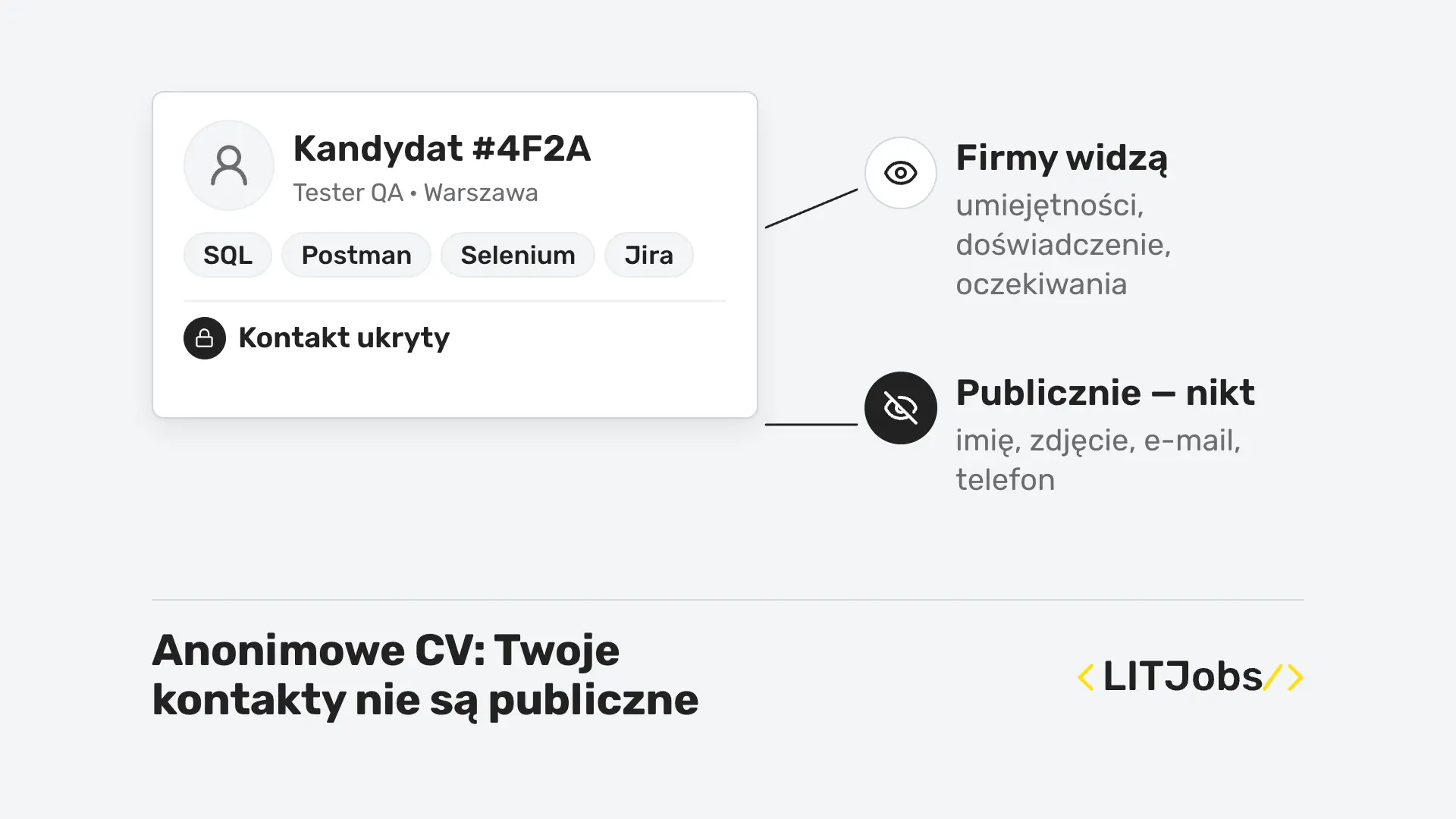
Anonymous CV: your contact details are never public
30 s · Polish voice-over · Polish captions, English subtitles
Video transcript
We never show your contact details publicly. Companies see your skills and experience — no name, no photo. A company that wants to talk asks for contact through LITJobs. We check the request and pass it on to you. Accept — the company sees your name and writes to you on the platform. Decline — the company gets none of your data. The decision is always yours. Add your CV for free.
Frequently asked questions
Do I need a photo on my CV in Poland?
No. A photo is not among the data an employer may require from a candidate under the Polish Labour Code. Many Polish CVs still include one, so it is a matter of choice. If you add it, processing your image is based on your consent, which is another reason to include the consent clause. In IT, a photo has practically no influence on how your application is assessed.
Can a Polish employer ask about my current salary?
Not any more. Since 24 December 2025 Article 22¹ of the Labour Code excludes information about pay in your current and previous jobs from the data an employer may require from a candidate. Instead, the employer must tell you the salary or its range – in the job ad, before the interview or before you sign the contract. You can answer salary questions with your expectations.
Should I write my CV in Polish or English?
Use the language of the job ad. If the ad is in English, an English CV is fine, even for a Polish company. If the ad is in Polish and you do not speak Polish well, an English CV is still acceptable for many international teams, but be honest about your Polish level. You can add the consent clause in Polish, or in both languages.
Should I mention my work permit or residence status?
Yes, briefly. A recruiter needs to know if you can start without the company applying for a work permit. One line in the contact section is enough, for example: “EU citizen – no work permit required” or “Temporary residence card with access to the labour market”. Check the exact wording of your own document; do not claim a status you do not have.
How long should a CV be for jobs in Poland?
One page for up to a few years of experience, two pages for longer careers. There is no legal rule. What matters is that a recruiter can find your job title, key skills, language levels and best results within seconds. Shorten older or less relevant roles to a single line.
Sources
- Zielona Linia (gov.pl) – CV clause: consent to personal data processing (legal status as of 23 Sept 2024, in Polish)
- ISAP – Polish Labour Code, consolidated text, Journal of Laws 2026 item 1245 (Art. 18³ᶜᵃ, Art. 22¹, in Polish)
- ELI (api.sejm.gov.pl) – Polish Labour Code, consolidated text, Journal of Laws 2026 item 1245 (Art. 18³ᶜᵃ, Art. 22¹) – PDF (in Polish)
- Zielona Linia (gov.pl) – Information an employer may request from a candidate and employee (in Polish)
- UODO (Polish Data Protection Authority) – Data protection in the workplace: guide for employers (in Polish)
- Council of Europe – CEFR language levels A1–C2
- Europass (European Commission) – CV builder
Figures and rules come from the sources below; salary data from LITJobs offers — see our methodology. How we work on our content
On this topic
GDPR Clause for a CV in Poland (2026)
The RODO (GDPR) consent clause for a CV in Poland in 2026: exact Polish wording from gov.pl, English translation, future consent and where to put it.
B2B vs employment contract in Poland (2026)
B2B or umowa o pracę in Poland in 2026: ZUS up to 1,926.76 PLN, health contribution, 12% lump-sum tax, net pay compared at 15,000 PLN and new PIP powers.
Data Scientist in Poland
How to become a data scientist in Poland in 2026: what the job involves, skills (Python, SQL, statistics, ML), junior vs senior pay and a plan.
DevOps in Poland
DevOps in Poland in 2026: what a DevOps engineer does, what to learn (Linux, Docker, CI/CD, cloud, Kubernetes), certifications, salaries and a plan.
Add your CV — let companies find you
A free anonymous profile: companies see your skills and you decide about contact.