GuidesCV & recruitment
GDPR (RODO) clause for a CV in Poland in 2026 – exact wording, English version and where to put it
The RODO (GDPR) consent clause for a CV in Poland in 2026: exact Polish wording from gov.pl, English translation, future consent and where to put it.
By LITJobs editorial team · LearnIT experts6 min read

Contents
The GDPR clause for a Polish CV – the short answer
A Polish CV usually ends with a one- or two-sentence consent clause, known as klauzula RODO (RODO is the Polish abbreviation for the GDPR). The short, current version published by the Polish government's labour information service Zielona Linia is:
Wyrażam zgodę na przetwarzanie moich danych osobowych przez [nazwa firmy]
w celu prowadzenia rekrutacji na aplikowane przeze mnie stanowisko.
Copy it, insert the company name from the job ad and place it at the very bottom of your CV in a slightly smaller font. Below you will find the English translation, the version for future recruitment, when the clause is actually needed and the old wording you should not use.
English translation
Our translation of the short clause and of the optional future-recruitment consent. Polish recruiters recognise the Polish wording best, so a common choice is Polish first, English below.
I consent to the processing of my personal data by [company name]
for the purpose of the recruitment process for the position I am applying for.

I also consent to the processing of my personal data for the purpose
of future recruitment processes by the above-mentioned company.
Future recruitment and special-category data
Without separate consent, the employer should delete your data once the recruitment ends, says the Polish Data Protection Authority (UODO). If you would like the company to consider you for later openings, add this sentence under the main clause:
Wyrażam również zgodę na przetwarzanie moich danych osobowych w celu
prowadzenia przyszłych rekrutacji przez wyżej wskazaną firmę.
You can limit it in time – UODO gives an example of consent to use data in future recruitment “for the next 6 months”.
If you voluntarily share special-category data, such as health information or a disability certificate, the employer may process it only with your explicit consent (Article 22¹ᵇ of the Labour Code). UODO's sample wording for that case:
Wyrażam zgodę na przetwarzanie szczególnych kategorii danych, o których mowa
w art. 9 ust. 1 RODO, które zamieściłem w liście motywacyjnym oraz załączonych
do niego dokumentach.
(“I consent to the processing of special categories of data referred to in Article 9(1) GDPR that I included in my cover letter and the attached documents.”)
When the clause is needed – and when it is not
- Does the job ad give its own clause?
- YesResult: Copy the employer's wording exactly – that is what applies in this recruitment.
- NoAre you applying to a company outside the EU, e.g. in the UK or the USA?
- YesResult: A clause is usually not expected – follow local CV conventions.
- NoDo you want the company to keep your CV for future openings?
- YesResult: Add the short clause plus the separate future-recruitment sentence.
- NoResult: Add the short clause – formally optional for basic data, but widely expected.
- Yes
- Yes
- Yes
The legal background: Article 22¹ of the Polish Labour Code lists the data an employer may require from a candidate – name, date of birth, contact details and, where necessary for the job, education, professional qualifications and work history (excluding information about pay in current and previous jobs). For this data the legal basis is the law itself, so consent is not formally required.
Other data, such as a photo or hobbies, may be processed on the basis of consent (Article 22¹ᵃ). UODO explains that sending your CV in response to a job ad can itself count as consent, because you know who receives your data and why. A clear sentence at the bottom of the CV removes any doubt – which is why Polish recruiters still expect it. The same article states that refusing or withdrawing consent may not lead to unfavourable treatment or a refusal of employment.
Where to put the clause
- At the very bottom of the last page, below your final section, in a smaller but readable font.
- Inside the CV file, not only in the e-mail – CVs are often stored in an applicant tracking system without the message.
- Once is enough. If you also send a cover letter, the clause in the CV covers both.
- Online forms usually have a separate consent checkbox; the clause in the file does no harm.
- Company name: update it for every application. When applying through a recruitment agency, use the agency's name or the wording from its ad.
How the clause fits into the full document is shown in our guide on writing a CV for jobs in Poland.
Mistakes to avoid
- Warning: A reference to the Personal Data Protection Act of 29 August 1997 – it has not applied since 2018; Zielona Linia calls this clause incorrect and outdated.
- Warning: Another company's name left over from a previous application.
- Warning: The clause only in the e-mail body and not in the CV file.
- Warning: Future-recruitment consent “for all companies” – consent is given to a specific employer.
- Warning: The clause pasted as an image – applicant tracking systems cannot read it.
- Warning: Calling the GDPR a Polish “act” – it is an EU regulation.
Withdrawing consent and your rights
You can withdraw consent at any time; this does not affect the lawfulness of processing before withdrawal (Article 7(3) GDPR). A short message is enough:
Dear Sir or Madam, I withdraw my consent to the processing of my personal
data submitted in my application for the position of [title] on [date]
and ask you to delete it. [Full name]
You also have the right to ask what data the company holds, to have it corrected or deleted, and to lodge a complaint with the President of UODO. The company's privacy notice (Article 13 GDPR) tells you how long it keeps CVs and whom to contact.
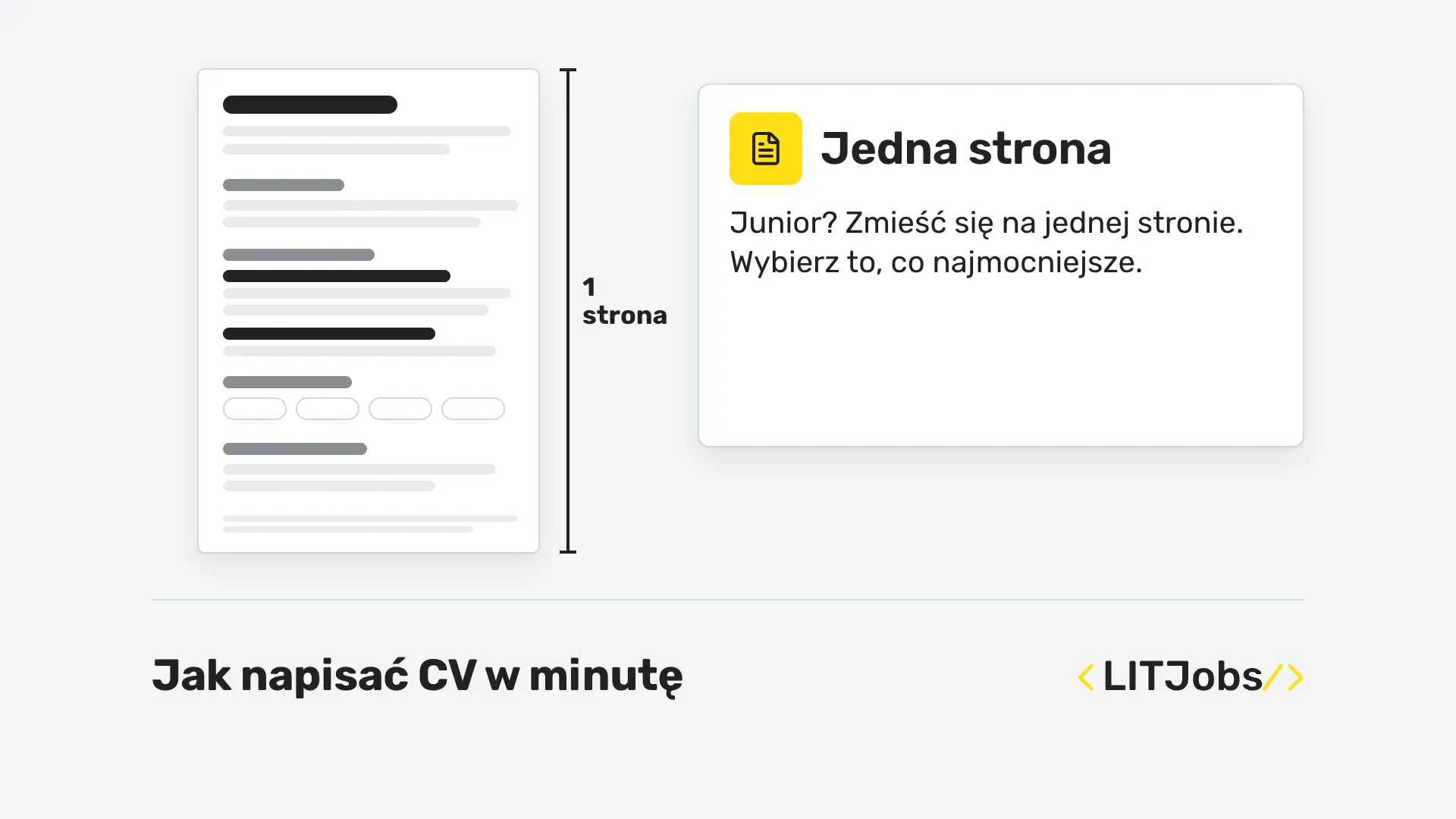
How to write a CV in a minute
60 s · Polish voice-over · Polish captions, English subtitles
Video transcript
Your CV in a minute: what to include and what to avoid. At the top: name, e-mail, phone, city and a GitHub or LinkedIn link. Summary: 2–3 sentences on who you are and what you're looking for. Experience or projects: newest first, with results. Skills and languages — specific and matched to the offer. Education and courses — briefly. ATS-friendly: a simple layout, standard headings, keywords from the ad. No tables or text inside images — the system may not read it. A GDPR clause at the bottom: not mandatory, but worth adding. Junior? Keep it to one page. Add your finished CV to LITJobs — your contact details stay hidden. Add your CV for free.
Your contact details stay private on LITJobs
You can add your CV to LITJobs as a candidate profile that works as your CV. Your phone number and e-mail are never shown publicly – a company that wants to reach you asks through LITJobs, and you decide whether to share them. Browse IT vacancies in Poland and remote positions, and if an offer is on a B2B basis, read our comparison of B2B and employment contracts first. Polish speakers can read the Polish version of this guide.
Want new skills and a certificate on your CV? LearnIT runs live online IT courses in Poland, some of which may qualify for public co-financing – ask which course fits the jobs you are applying for.
Ask about a course and funding
Leave your contact details — a LearnIT advisor will tell you about the course, dates and possible funding.
Frequently asked questions
What is the exact RODO clause for a CV in Poland?
The short version published by Zielona Linia reads: “Wyrażam zgodę na przetwarzanie moich danych osobowych przez [nazwa firmy] w celu prowadzenia rekrutacji na aplikowane przeze mnie stanowisko.” In English: “I consent to the processing of my personal data by [company name] for the purpose of the recruitment process for the position I am applying for.” Replace the brackets with the company name from the job ad.
Is the GDPR clause legally required on a CV in Poland?
Not strictly for the basic data in Article 22¹ of the Labour Code – name, date of birth, contact details and, where needed, education, qualifications and work history. Here the legal basis is the law itself. Consent is needed for extra data, such as a photo, for future recruitment, or when the job ad asks for a clause. Since many Polish employers expect it, adding it is the safe choice.
Should the clause be in Polish or English?
Either works for an English-language application to a company in Poland. Polish recruiters know the Polish wording best, so many candidates add the Polish sentence with the English translation below it. If the job ad provides its own clause in either language, copy that exact text. For applications to companies outside the EU, such as in the UK or the USA, a clause is usually not added.
Can a Polish employer reject me for not adding the clause?
Under Article 22¹ᵃ of the Labour Code, refusing or withdrawing consent may not be a reason for unfavourable treatment or for refusing employment. In practice, though, some recruiters set aside CVs without a clause, especially when the ad asked for one. Adding two sentences costs nothing, so it is not worth the risk.
How do I withdraw my consent after applying?
Send a short message to the company, ideally to the address in its privacy notice or to its data protection officer, saying that you withdraw your consent to the processing of your personal data in the recruitment and ask for deletion. Under Article 7(3) GDPR, withdrawal does not affect the lawfulness of processing before it. You may also ask what data the company holds about you.
Sources
- Zielona Linia (gov.pl) – CV clause: consent to personal data processing (in Polish, legal status as of 23 Sept 2024)
- UODO (Polish Data Protection Authority) – Data protection in the workplace: guide for employers (in Polish)
- ISAP – Polish Labour Code, consolidated text, Journal of Laws 2026 item 1245 (Art. 22¹, 22¹ᵃ, 22¹ᵇ, in Polish)
- ELI (api.sejm.gov.pl) – Polish Labour Code, consolidated text, Journal of Laws 2026 item 1245 (Art. 22¹, 22¹ᵃ, 22¹ᵇ) – PDF (in Polish)
- EUR-Lex – Regulation (EU) 2016/679 (GDPR), incl. Art. 6, 7(3), 9 and 13
Figures and rules come from the sources below; salary data from LITJobs offers — see our methodology. How we work on our content
On this topic
How to Write a CV in Poland (2026)
How to write a CV for jobs in Poland in 2026: the structure recruiters expect, your work status line, a ready template, ATS rules and tips for IT roles.
B2B vs employment contract in Poland (2026)
B2B or umowa o pracę in Poland in 2026: ZUS up to 1,926.76 PLN, health contribution, 12% lump-sum tax, net pay compared at 15,000 PLN and new PIP powers.
Add your CV — let companies find you
A free anonymous profile: companies see your skills and you decide about contact.