CareersCybersecurity
Cybersecurity specialist in Poland — roles, skills and a path from zero
Cyber security jobs in Poland in 2026: SOC analyst or pentester, skills, Security+ and other certifications, NIS2 demand and a realistic plan from zero.
By LITJobs editorial team · LearnIT experts9 min read

Contents
- What does a cybersecurity specialist do?
- Skills: must-have and nice-to-have
- How to become a cybersecurity specialist: a plan from scratch
- Step 1: Build the foundations — networks and systems
- Step 2: Learn attacks and defences
- Step 3: Practise in labs and CTFs
- Step 4: Earn an entry-level certification
- Step 5: Document your practice and apply widely
- Cybersecurity certifications that matter
- Cybersecurity salaries in Poland
- The market: NIS2, DORA and juniors
- Career paths after the SOC
- Remote work in cybersecurity
- Cybersecurity jobs
- Cybersecurity course and funding options in Poland
- Related career paths
A cybersecurity specialist protects a company’s systems, data and people from attacks: monitoring events, responding to incidents, building and testing defences, and keeping the organisation compliant with regulations. To break into cyber security in Poland from scratch, you first need a solid grasp of networking, Linux and Windows, then hands-on lab practice and one entry-level certification. The most common first job is a SOC analyst, not a penetration tester.
This guide covers security roles, required skills, a learning plan with a realistic timeline, certifications and the state of the Polish market.
What does a cybersecurity specialist do?
“Cybersecurity” is several different jobs. Choose a direction before you start learning — it determines your priorities.
| Role | What they do | Who it suits |
|---|---|---|
| SOC analyst (L1/L2) | monitors SIEM alerts, triages events, escalates incidents | the most common entry point for juniors |
| Incident responder / DFIR | handles incidents, analyses evidence, reconstructs attacks | after SOC experience |
| Penetration tester / red team | tests applications, networks and people using attacker techniques | technical, very persistent people |
| Security engineer / cloud security | implements controls: IAM, firewalls, EDR, hardening, cloud | often former admins and DevOps engineers |
| GRC / compliance specialist | policies, risk analysis, audits, NIS2, DORA, ISO 27001 compliance | analytical people with an interest in law |
A day in a SOC
A SOC analyst begins the shift by reviewing open tickets, then works through alerts: a login from an unusual country, a suspicious process on a workstation, a spike in traffic to an unknown domain. For each alert they check the context in the logs, decide whether it is a false positive and document the decision. Real incidents are escalated according to procedures:
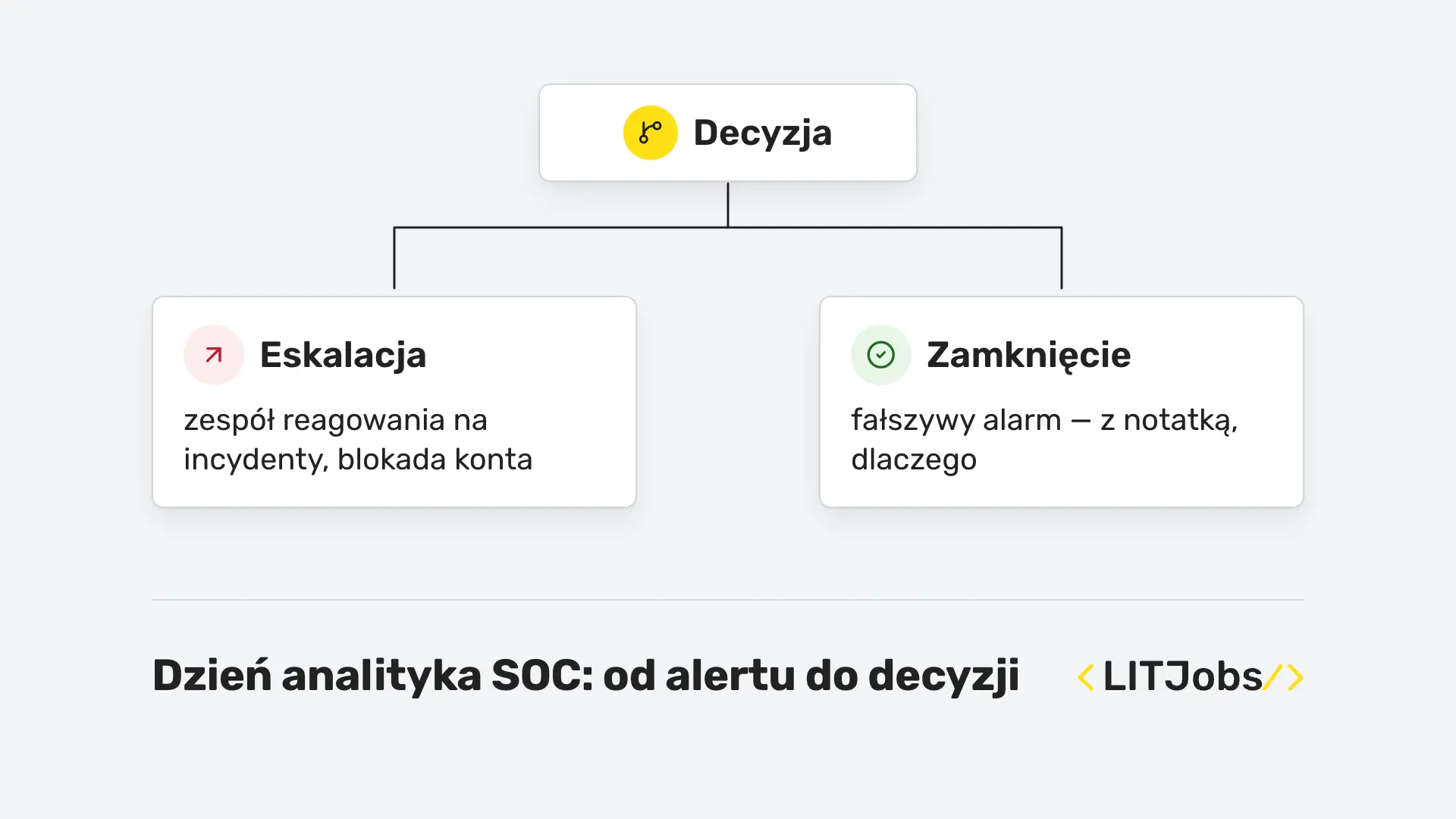
A SOC analyst's day: from alert to decision
30 s · Polish voice-over · Polish captions, English subtitles
Video transcript
A SOC analyst starts the day with an alert: an unusual sign-in. Triage: is it a real threat, and how urgent is it? Investigation: logs, IP addresses, account history. The analyst links the facts into one timeline. Decision: escalate to the incident response team… …or close the alert with a note on why. Browse job offers.
Writing is a big part of the job — analysis notes must be clear to the next shift and to auditors.
Penetration testers work differently: on projects, within a scope agreed with the client, and a large share of their time goes into the findings report. We cover certifications, labs and the legal limits in a separate guide for future pentesters (in Polish).
Skills: must-have and nice-to-have
| Area | Must-have to start | Nice-to-have |
|---|---|---|
| Networking | TCP/IP, DNS, HTTP/HTTPS, subnets, ports, Wireshark | VPN, segmentation, proxies, WAF |
| Systems | Linux (command line, permissions, logs), Windows and Active Directory | hardening, PowerShell, Group Policy |
| Security | CIA triad, common attacks (phishing, ransomware, OWASP Top 10), MITRE ATT&CK | malware analysis, threat hunting |
| Tools | SIEM basics (e.g. Splunk, Microsoft Sentinel, Elastic), Nmap | Burp Suite, EDR, Sigma and YARA rules |
| Scripting | Bash or Python basics | automating analysis, building tools |
| Cloud | AWS or Azure basics, shared responsibility model | IAM, cloud logging, CSPM |
| Soft skills | accuracy, calm under pressure, report writing, English B2 | explaining risk to business stakeholders |
How to become a cybersecurity specialist: a plan from scratch
Security builds on other disciplines — you cannot secure a network you do not understand. That is why the realistic timeline is longer than, say, software testing.
| Stage | What you learn | Approximate time (10–15 h per week) |
|---|---|---|
| IT fundamentals | networking, Linux, Windows, AD | 3–4 months |
| Security basics | attacks, defence, MITRE ATT&CK, OWASP | 2–3 months |
| Practice | labs, CTFs, a home SIEM | 3–6 months (in parallel) |
| Entry certification | Security+ or ISC2 CC | 1–2 months of preparation |
| Job search | CV, interviews, practical tasks | a few weeks to a few months |
Starting from zero, expect 9–18 months before your first job that is strictly in security. People with helpdesk, admin or programming experience move faster.
Step 1: Build the foundations — networks and systems
Learn how a packet travels across a network: IP addressing, routing, DNS, TCP and UDP, TLS. Install Wireshark and inspect your own browser traffic. In parallel, work in the Linux terminal — users, permissions, processes, system logs. Set up a Windows Server virtual machine with a simple Active Directory domain: that is exactly what attackers target in most companies. If this is all new to you, a helpdesk job is a common first step — see our IT support guide (in Polish).
Step 2: Learn attacks and defences
Work through the OWASP Top 10 (the most common web application vulnerabilities) and the MITRE ATT&CK matrix (attacker tactics and techniques). Learn in “attack — detection” pairs: once you know how a brute-force login attack works, look at how it appears in logs and which SIEM rule would catch it.
Start with the attack every company faces — phishing. Three warning signs in 15 seconds:
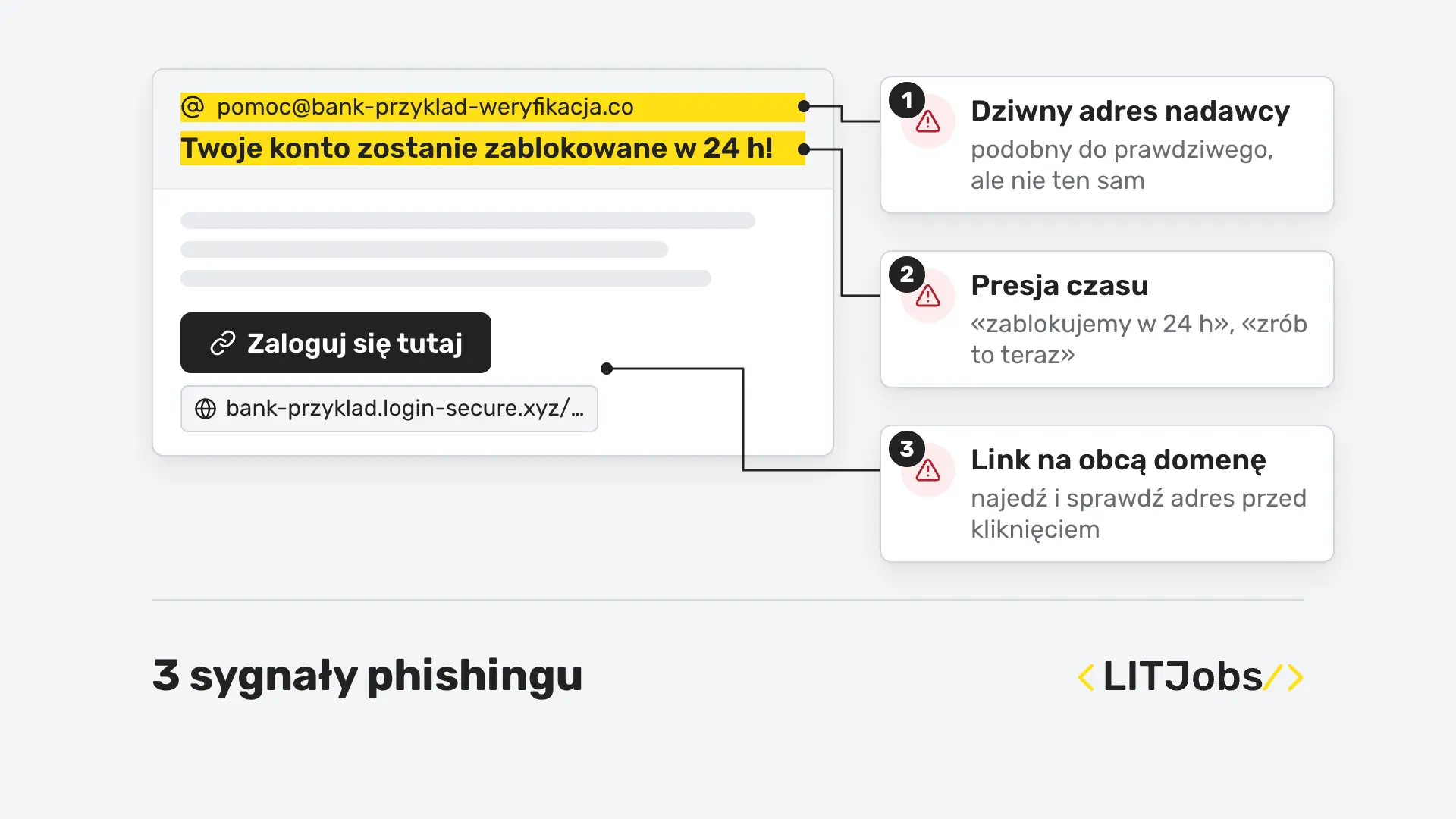
3 signs of phishing
15 s · Polish voice-over · Polish captions, English subtitles
Video transcript
3 signs of phishing. 1. A sender address that is almost the real one. 2. Pressure: “do it now”. 3. The link leads to a different domain. Browse job offers.
Step 3: Practise in labs and CTFs
Hands-on practice matters more here than in many other jobs. Use training platforms with ready-made labs and CTF challenges; follow both blue-team paths (log and incident analysis) and red-team paths (gaining access). Important: only test systems you have permission to test — testing someone else’s systems without the owner’s consent can be a criminal offence in Poland.
Build a home lab: a few virtual machines, a free SIEM (such as Elastic or Wazuh) and simulated attacks. A documented lab in a repository impresses recruiters more than a list of completed courses.
Step 4: Earn an entry-level certification
Pick one that matches your direction: Security+ for SOC and general security, ISC2 CC as a first proof of fundamentals, eJPT for future penetration testers. The full ladder is below; our overview of IT certifications worth having (in Polish) explains how to tell valuable credentials from empty certificates.
Step 5: Document your practice and apply widely
Write up your lab setup, solved challenges (without publishing solutions if the platform forbids it) and a sample incident report. Apply not only for “security” roles but also for helpdesk and administration roles with a security component, and for IT internships (in Polish) in security teams. Our CV guide for Poland explains the format Polish recruiters expect, the RODO clause page gives the exact consent wording, and you can upload your CV to LITJobs so recruiters can find you.
In interviews, expect questions such as “what happens when you type an address into a browser?”, “how do you recognise phishing?” or “what do you do when the SIEM shows logins from two countries within a minute?”.
Cybersecurity certifications that matter
- Level 1: Start
- CompTIA Security+
- ISC2 Certified in Cybersecurity (CC)
- eJPT (INE) — for future pentesters
- Level 2: After your first job
- Microsoft SC-200 (SOC analyst)
- CompTIA CySA+
- AWS or Azure security certifications
- Level 3: Specialisation
- OSCP (OffSec) — penetration testing
- ISO/IEC 27001 Lead Implementer or Auditor — GRC
- Level 4: Senior and lead
- CISSP (ISC2) — requires 5 years of experience
- CISM
A few facts worth knowing: ISC2 CC requires no work experience, but ISC2’s free “One Million Certified in Cybersecurity” programme closed to new enrolments on 20 May 2026. CompTIA currently offers Security+ V7 and has announced V8 for November 2026 — check which version you are preparing for before buying a voucher. Do not collect certificates “just in case”: one well-chosen entry certification plus lab practice is worth more than three theoretical exams.
Cybersecurity salaries in Poland
Salary ranges from security job offers on LITJobs:
There are not enough offers with salary ranges in this category on LITJobs yet to show a median — we show it from 3 ranges (see our methodology). Until then, rely on the reports cited in the text.
Security is one of the better-paid areas of IT, but the spread is huge: a first-line SOC junior earns far less than an experienced penetration tester or cloud security architect. The Bulldogjob 2025 survey has no separate security category, so we do not quote a single median here. According to the No Fluff Jobs report “Rynek pracy IT 2025/2026” (summarised by Antyweb on 28 January 2026), lower B2B salary medians in the Security category rose by more than ten percent in 2025. For a full comparison of the two contract types, see B2B vs employment contract in Poland.
The market: NIS2, DORA and juniors
Regulation keeps demand high. The Act of 23 January 2026 amending the National Cybersecurity System Act (KSC), which implements the EU NIS2 directive, was published in the Journal of Laws on 2 March 2026 (item 252) and took effect one month later. It covers far more organisations than before — including energy, transport, healthcare, manufacturing and digital services. Entities that qualified as essential or important when the act took effect have 12 months to meet its obligations, and essential entities have 24 months for their first audit. The financial sector has applied the EU DORA regulation since 17 January 2025. This drives demand for both SOC technicians and GRC specialists.
At the same time, “junior pentester” openings are rare and highly contested. A realistic strategy:
- target SOC L1, helpdesk with access to security tools, or system administration — see junior IT jobs in Poland;
- consider managed security service providers (MSSPs) — they hire juniors more often and train them fast;
- if you have a background in law, audit or risk management, GRC may be the fastest route.
Career paths after the SOC
A SOC is the most common starting point, not the end of the road. After a year or two analysts usually choose one of these branches:
- SOC L2 / L3
deeper analysis, threat hunting, writing detection rules
- Incident response / DFIR
incident handling, evidence and malware analysis
- Penetration tester
application and infrastructure testing, hands-on certifications
- Cloud security engineer
IAM, logging, AWS or Azure controls, DevSecOps
- GRC specialist
risk analysis, policies, NIS2, DORA and ISO 27001 audits
The easiest routes in come from helpdesk and administration (you already know systems and accounts), programming and testing (you understand applications from the inside — a good base for DevSecOps), audit and law (a natural route into GRC), and the military, public services and telecoms.
Remote work in cybersecurity
Penetration testing, GRC and cloud security engineering are often remote or hybrid — browse remote IT jobs in Poland. SOCs usually run in shifts, and some companies require on-site work for security reasons. Public institutions and the defence sector add security clearance requirements and on-site work.
Cybersecurity jobs
Latest offers in the Cybersecurity category:
Cybersecurity course and funding options in Poland
LearnIT runs an online cybersecurity course from the basics, with a strong focus on hands-on labs. If you live and work in Poland, part of the cost can often be covered by public funding — the main routes are summarised below, and our step-by-step guide to co-financed IT courses (in Polish) covers the paperwork and deadlines.
Funding for an IT course
A course can be paid for partly or fully from public funds. Whether you get it, and how much, is decided by the programme operator or the office — not by the school.
- BUR (Development Services Database) — co-financing of adult training in regional programmes; there is no single national rate, the level and rules are set by the regional operator.
- Labour office — e.g. a lifelong-learning voucher (bon na kształcenie ustawiczne) or a training referral for people registered as unemployed or job seekers.
- KFS (National Training Fund) — when your employer pays for the training.
Sources: Development Services Database (PARP) · Act on the labour market and employment services (Dz.U. 2025 item 620) · Public employment services — KFS 2026 (psz.praca.gov.pl)
Ask about a course and funding
Leave your contact details — a LearnIT advisor will tell you about the course, dates and possible funding.
Related career paths
- DevOps engineer — for those who want to secure cloud and pipelines (DevSecOps).
- Data scientist — anomaly detection and security analytics use data science methods.
- Penetration tester (in Polish) — pentesting step by step: certifications, labs and legal limits.
- Cybersecurity jobs — browse current openings.
Frequently asked questions
What is cyber security and what does a specialist actually do?
Cyber security is the protection of systems, networks, data and users against attacks and failures. A specialist may monitor alerts in a SOC, handle incidents, configure defences such as EDR, firewalls and cloud access controls, test systems using attacker techniques, or work on risk analysis and regulatory compliance. Each of these roles needs a different skill set, so it pays to choose a direction early in your learning.
How much does a cybersecurity specialist earn in Poland?
Security is among the better-paid areas of IT, but junior SOC salaries usually start at a level similar to other specialisations and grow with experience and certifications. According to the No Fluff Jobs report “Rynek pracy IT 2025/2026”, lower B2B salary medians in the Security category rose by more than ten percent in 2025. Current ranges from LITJobs offers are shown in the salary section.
Do I need to code to work in cybersecurity?
You do not need to be a software developer, but scripting helps a lot. Python and Bash are useful for automating log analysis, writing small tools and understanding exploits. People testing web applications must understand how server-side and browser code works. GRC specialists code rarely but need strong knowledge of regulations, standards such as ISO 27001 and risk assessment.
SOC analyst or penetration tester — where should a beginner start?
For most beginners a SOC is the better start. There are more first-line analyst openings, companies are more willing to train juniors, and the work gives you real exposure to attacks and logs. Junior pentester roles are rare and highly contested, and recruiters expect lab practice and a hands-on certification. Many people start in a SOC or in administration and move into penetration testing after a year or two.
How long does it take to get a first cybersecurity job from scratch?
With 10–15 hours of study a week, usually 9–18 months. You first need networking, Linux, Windows and Active Directory, then common attacks and defences, while practising in labs and preparing for an entry-level certification. People with helpdesk, administration, programming or testing experience move noticeably faster, because they already have the technical foundations that security builds on.
How do NIS2 and the new KSC Act affect cybersecurity hiring in Poland?
The amended National Cybersecurity System Act, which implements the NIS2 directive, covers far more organisations than before and imposes duties such as risk management, incident handling and reporting, and audits. Entities that qualified as essential or important when the act took effect have 12 months to meet its obligations. That raises demand for SOC analysts, security engineers and GRC specialists.
Do cybersecurity jobs in Poland require Polish?
Many roles in international companies, shared service centres and security service providers are in English. Polish is usually required in the public sector, critical infrastructure, defence, and GRC roles that work closely with Polish law and regulators. Some public-sector and defence roles also require a Polish security clearance, which is generally available only to people meeting specific legal requirements.
Sources
- Journal of Laws 2026, item 252 — Act of 23 January 2026 amending the National Cybersecurity System Act (NIS2), published 2 March 2026 (in Polish)
- EUR-Lex — Regulation (EU) 2022/2554 (DORA), applicable from 17 January 2025
- Antyweb (28 January 2026) — summary of the No Fluff Jobs report “Rynek pracy IT 2025/2026” (in Polish)
- CompTIA — Security+ (V7 current; V8 announced for November 2026)
- ISC2 — Certified in Cybersecurity (CC): no work experience required
- ISC2 — One Million Certified in Cybersecurity: enrolment closed on 20 May 2026
- ISC2 — CISSP: 5 years of required work experience
- Microsoft Learn — Security Operations Analyst Associate (SC-200)
- MITRE ATT&CK — adversary tactics and techniques
- OWASP Top 10 — the most common web application risks
Figures and rules come from the sources below; salary data from LITJobs offers — see our methodology. How we work on our content
On this topic
DevOps in Poland
DevOps in Poland in 2026: what a DevOps engineer does, what to learn (Linux, Docker, CI/CD, cloud, Kubernetes), certifications, salaries and a plan.
Data Scientist in Poland
How to become a data scientist in Poland in 2026: what the job involves, skills (Python, SQL, statistics, ML), junior vs senior pay and a plan.
B2B vs employment contract in Poland (2026)
B2B or umowa o pracę in Poland in 2026: ZUS up to 1,926.76 PLN, health contribution, 12% lump-sum tax, net pay compared at 15,000 PLN and new PIP powers.
GDPR Clause for a CV in Poland (2026)
The RODO (GDPR) consent clause for a CV in Poland in 2026: exact Polish wording from gov.pl, English translation, future consent and where to put it.
Jobs: Cybersecurity
Current offers with salary ranges from verified companies.