GuidesContracts & taxes
B2B contract vs employment contract (UoP) in Poland in 2026 – what pays off in IT
B2B or umowa o pracę in Poland in 2026: ZUS up to 1,926.76 PLN, health contribution, 12% lump-sum tax, net pay compared at 15,000 PLN and new PIP powers.
By LITJobs editorial team · LearnIT experts7 min read

Contents
B2B vs UoP in Poland – the short answer
In Poland in 2026, choosing between a B2B contract and an employment contract (umowa o pracę, UoP) is mainly a trade-off between more money now and legal protection. On B2B you invoice a client from your own sole proprietorship (jednoosobowa działalność gospodarcza) and pay lump-sum social contributions and a business tax, which usually leaves more net income for the same rate. On UoP you get paid leave, sick pay, a notice period, the minimum wage guarantee and pension contributions on your full salary.
Figures below are for 2026 and come from ZUS, biznes.gov.pl and podatki.gov.pl. This guide is informational and is not tax advice.
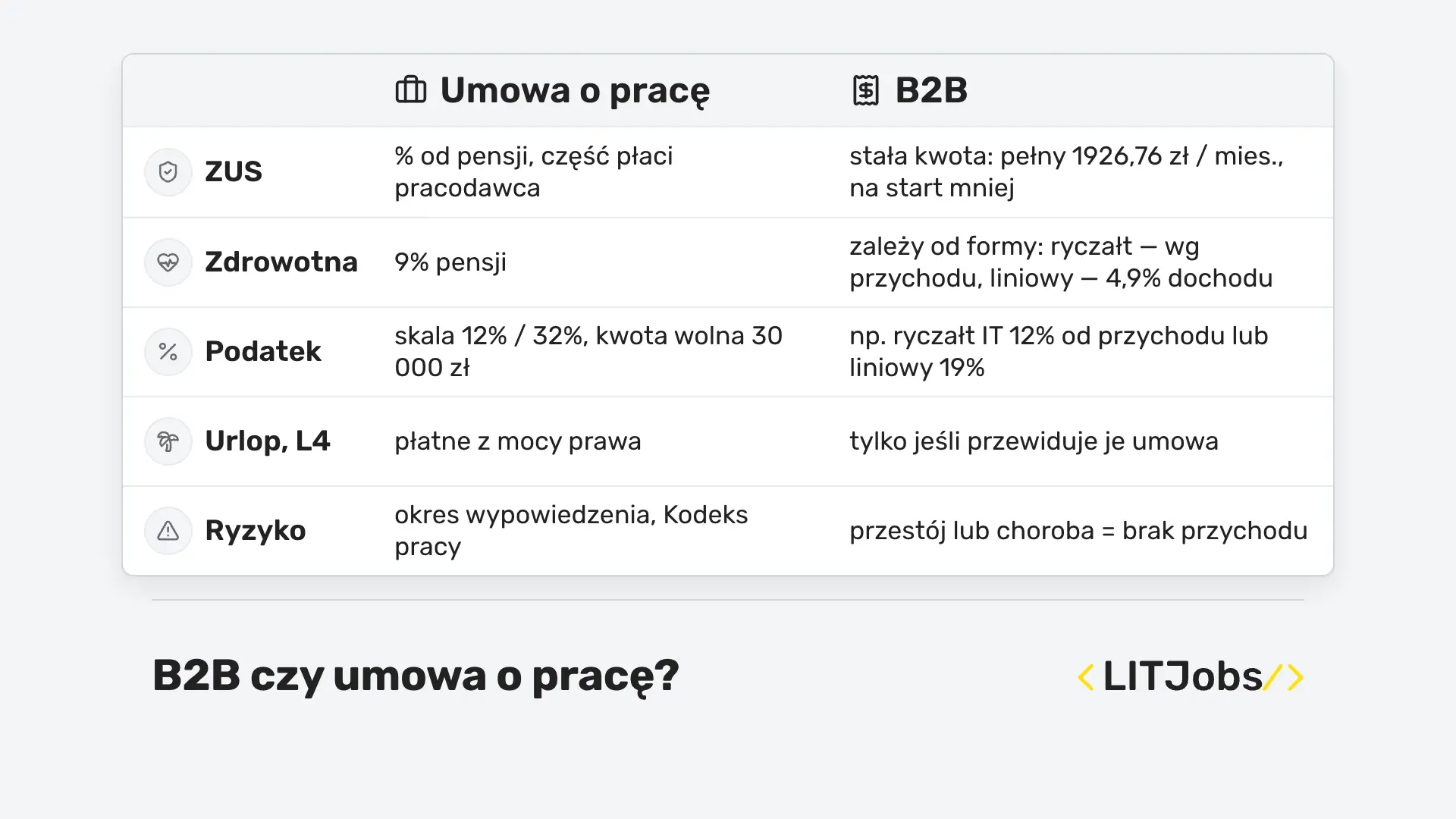
B2B or an employment contract? What changes for the same amount
60 s · Polish voice-over · Polish captions, English subtitles
Video transcript
The same amount: employment contract or B2B? What changes is what's left of it and what comes with it. Social security (ZUS): on a contract, a percentage of the salary. On B2B a fixed amount — the full rate is PLN 1,926.76 a month. Health contribution: 9% on a contract; on B2B it depends on the tax form. Tax: a contract uses the 12/32% scale; B2B e.g. 12% lump-sum tax or the 19% flat tax. Paid leave and sick pay: guaranteed on a contract; on B2B only if the agreement provides them. Risk: on B2B, downtime or illness means no income. For the same amount, B2B usually leaves more in your pocket. A contract gives you paid leave, sick pay and stability instead. Compare annual net income, not just the rate. Work out your own case in the B2B / employment calculator. Try the calculator.
Side-by-side comparison
| Employment contract (UoP) | B2B (sole proprietorship) | |
|---|---|---|
| Legal basis | Labour Code | Civil Code, contract between businesses |
| Paid leave | 20 or 26 days a year | only if the contract says so |
| Sick leave | sick pay and benefit | benefit only with voluntary sickness insurance, no invoice income |
| Notice | statutory periods and protection | as agreed, often short |
| Social security (ZUS) | on full salary, partly paid by employer | lump-sum – minimum base 5,652 PLN on full ZUS in 2026 |
| Income tax | progressive scale 12% / 32% | choice: scale, 19% flat, lump-sum (12% for most IT work), optionally IP Box 5% |
| Equipment and tools | provided by employer | your costs (deductible on scale and flat tax) |
| Admin | none | CEIDG registration, accounting, e-invoices in KSeF |
| Under-26 tax relief | yes | no |
Net pay for the same amount
We calculated the average monthly take-home pay in 2026 for 15,000 PLN: gross on an employment contract and net (excluding VAT) on a B2B invoice.
Source: LITJobs calculation on 2026 ZUS, PIT and health contribution rates (biznes.gov.pl, zus.pl)
Assumptions: on UoP – standard 250 PLN monthly costs, PIT-2 filed, no PPK, no 50% author's costs, 32% bracket applied over the year. On B2B – full ZUS with sickness insurance (1,926.76 PLN), 2026 health contribution rules, contribution deductions as allowed by law, no other business costs and no accounting fees. In the last case you issue no invoice for one month (holiday, illness, gap between projects) but keep paying ZUS. With the same assumptions at 10,000 PLN, UoP leaves about 7,147 PLN and B2B on the lump-sum about 6,307 PLN – so B2B is not automatically better.
Employment contract: how pay is taxed
From the gross salary the employee pays social contributions (pension 9.76%, disability 1.5%, sickness 2.45%), the 9% health contribution and income tax on the progressive scale – 12% up to 120,000 PLN of annual income and 32% above, with a 30,000 PLN tax-free amount. Developers whose work is a copyrighted creation can have 50% author's costs applied to part of their salary, within an annual cap. People under 26 do not pay PIT on employment and mandate-contract income up to 85,528 PLN a year.
The employer adds its own contributions on top, so the total cost of a job is higher than the gross salary in your contract – the main reason companies offer higher B2B rates.
B2B: ZUS and health contribution in 2026
| Stage | Contribution base | Monthly ZUS (social incl. sickness, plus Labour and Solidarity Funds) |
|---|---|---|
| Start-up relief (ulga na start), first 6 months | – | 0 PLN (health contribution only) |
| Reduced ZUS (preferencyjny), next 24 months | 1,441.80 PLN | 456.18 PLN |
| Mały ZUS Plus (revenue up to 120,000 PLN last year) | income-based | individual |
| Full ZUS | 5,652 PLN | 1,926.76 PLN |
Health contribution: on the tax scale 9% of income, on the flat tax 4.9% of income – in both cases at least 432.54 PLN a month from February 2026. On the lump-sum tax it is fixed by annual revenue: 498.35 PLN (up to 60,000 PLN), 830.58 PLN (60,000–300,000 PLN) or 1,495.04 PLN (above 300,000 PLN).
B2B: which tax form
- Lump-sum tax (ryczałt) 12% on revenue for software-related services – creating, modifying, testing and developing software. Some IT services not related to software may qualify for 8.5%, but 2026 rulings for the same PKWiU code went both ways, so describe your services precisely.
- Flat tax 19% on income (revenue minus costs), no tax-free amount and no 32% bracket, but the 4% solidarity levy applies to income above 1 million PLN a year; health contributions deductible up to 14,100 PLN in 2026.
- Progressive scale 12% / 32% with the 30,000 PLN tax-free amount – often best for lower income or the first year.
- IP Box 5% on income from qualifying IP, including copyright to software you create or improve within R&D activity. It works with the scale or flat tax, not the lump-sum, and requires ongoing separate records – rulings have refused the relief to people who prepared records after the fact.
You cannot use the lump-sum or flat tax if you provide your former or current employer with the same work you did as their employee in the current or previous tax year.
VAT: most IT services for Polish companies carry 23% VAT; the small business exemption limit is 240,000 PLN in 2026, but advisory services cannot use it. Invoices are issued in the national e-invoicing system KSeF: mandatory since 1 February 2026 for the largest taxpayers and since 1 April 2026 for everyone else; until the end of 2026 businesses invoicing up to 10,000 PLN gross a month may still issue invoices outside KSeF, and penalties apply from 1 January 2027 – check the details for your business with your accountant.
Yearly average: PLN 5,783.91
| Gross | PLN 8,000.00 |
|---|---|
| Pension contribution (9.76%) | − PLN 780.80 |
| Disability contribution (1.5%) | − PLN 120.00 |
| Sickness contribution (2.45%) | − PLN 196.00 |
| Health insurance (9%) | − PLN 621.29 |
| PIT advance | − PLN 498.00 |
| Net | PLN 5,783.91 |
Employer's cost: PLN 9,638.40
For information only: we assume a full-time job, a 1.67% accident rate and no other deductions. 2026 rates per ZUS and the Ministry of Finance.
Open the full salary calculatorThe "disguised employment" risk
The Labour Code states that work performed under the conditions of an employment relationship is employment, whatever the contract is called. Since 8 July 2026 an amendment to the Labour Inspectorate Act (Journal of Laws 2026 item 473) lets the district labour inspector issue a decision confirming an employment relationship if the company ignores an inspector's earlier order. The decision can be appealed to the labour court. Warning signs: fixed hours and place set by the client, reporting lines like a regular employee, a ban on other clients and no business risk on your side.
What may change in 2027
On 29 September 2026 the government sent to the Sejm a bill changing income tax from 2027 (print no. 3147). The Sejm passed it on 22 October 2026 and the Senate proposed amendments on 27 October. As passed by the Sejm, from 1 January 2027 it raises the first threshold from 120,000 to 130,000 PLN, adds a 24% rate for income between 130,000 and 150,000 PLN (32% above), raises the solidarity levy from 4% to 5%, and lowers the lump-sum tax revenue limit from 2 million to 250,000 euro, with 17% on revenue above 300,000 euro in a year. As of 28 October 2026 it still awaits the vote on the Senate amendments and the President's signature – check the final wording before choosing your form of taxation for 2027.
How to decide
- Are you under 26 and earning up to PLN 85,528 a year?
- YesResult: An employment or mandate contract usually wins – the youth relief exempts them from PIT, B2B does not.
- NoAfter unpaid leave and a reserve, does B2B still pay clearly more than employment?
- YesAre you planning a mortgage or parental leave in the next year, or do you value stability most?
- YesResult: Choose an employment contract or negotiate a higher gross salary.
- NoResult: B2B makes sense – secure paid days off in the contract and check the tax form.
- Yes
- Yes
- Yes
Choose B2B if you have enough experience that the net difference covers unpaid leave and a reserve, and you are fine running a small business. Choose UoP if you are starting your career, are under 26, plan a mortgage or parental leave, or the difference shrinks after counting paid days off. Many ads on LITJobs show both rates – compare them in IT job offers and remote jobs, then plug the numbers into the salary calculator. Our career guides for DevOps engineers, data scientists and cybersecurity specialists show what these roles typically involve, and the guide on writing a CV for Poland helps you get to the offer stage.
Frequently asked questions
Is B2B or an employment contract better in Poland?
For the same headline figure, B2B usually leaves you more money each month because contributions and tax are lower, especially on the lump-sum or flat tax. An employment contract gives paid leave, sick pay, a statutory notice period and pension contributions on your full salary. Compare yearly net income after unpaid days off and business costs, not the headline rates.
How much is ZUS on B2B in 2026?
Full ZUS contributions for sole traders in 2026 are calculated on a base of 5,652 PLN (60% of the forecast average wage of 9,420 PLN) and amount to 1,926.76 PLN a month: social insurance including voluntary sickness insurance, plus the Labour Fund and Solidarity Fund. The health contribution comes on top and depends on the tax form, e.g. 830.58 PLN a month on the lump-sum tax with revenue between 60,000 and 300,000 PLN.
Can a foreigner work on B2B in Poland?
Citizens of the EU, EEA, Switzerland and the USA can run a sole proprietorship in Poland on the same terms as Poles. Other foreigners need a residence title that gives this right, for example a permanent residence permit, EU long-term resident status, an EU Blue Card or certain temporary residence permits. Since 5 March 2026 Ukrainian citizens can newly register on the same terms as Poles only with PESEL UKR status or another qualifying title; a temporary residence and work permit is not enough. Check your document against biznes.gov.pl.
Do I get paid holiday on B2B?
Not by law. Paid annual leave under the Labour Code applies to employees. On B2B, paid breaks exist only if your contract with the client provides for them. Otherwise every day off or sick day means no invoice for that day, so build it into your rate and keep a reserve.
Sources
- biznes.gov.pl – Social security contributions paid by entrepreneurs (2026 amounts)
- biznes.gov.pl – Start-up relief (ulga na start): 6 months without social contributions (in Polish)
- biznes.gov.pl – Health contribution amounts (2026)
- ZUS – Health contribution base and amounts in 2026
- biznes.gov.pl – Progressive tax scale rules
- podatki.gov.pl – Relief for young people under 26
- Ministry of Finance, Eureka – individual ruling on 12% vs 8.5% lump-sum rate for IT services (2026)
- podatki.gov.pl – VAT small business exemption
- ISAP – Act of 11 March 2026 amending the National Labour Inspectorate Act (Journal of Laws 2026 item 473, in force from 8 July 2026, in Polish)
- ELI (api.sejm.gov.pl) – Act of 11 March 2026 amending the National Labour Inspectorate Act (Journal of Laws 2026 item 473, in force from 8 July 2026) – PDF (in Polish)
- Sejm – print no. 3147 and legislative process (PIT, CIT and lump-sum tax changes from 2027, in Polish)
- KSeF (podatki.gov.pl) – When KSeF e-invoicing is mandatory (in Polish)
- biznes.gov.pl – What business activity can a foreigner run in Poland
- biznes.gov.pl – How a Ukrainian citizen can set up a business in Poland
Figures and rules come from the sources below; salary data from LITJobs offers — see our methodology. How we work on our content
On this topic
How to Write a CV in Poland (2026)
How to write a CV for jobs in Poland in 2026: the structure recruiters expect, your work status line, a ready template, ATS rules and tips for IT roles.
Cybersecurity Specialist in Poland
Cyber security jobs in Poland in 2026: SOC analyst or pentester, skills, Security+ and other certifications, NIS2 demand and a realistic plan from zero.
Data Scientist in Poland
How to become a data scientist in Poland in 2026: what the job involves, skills (Python, SQL, statistics, ML), junior vs senior pay and a plan.
DevOps in Poland
DevOps in Poland in 2026: what a DevOps engineer does, what to learn (Linux, Docker, CI/CD, cloud, Kubernetes), certifications, salaries and a plan.
Work out your take-home pay
2026 calculators: employment, mandate and B2B — ZUS, health and tax month by month.